
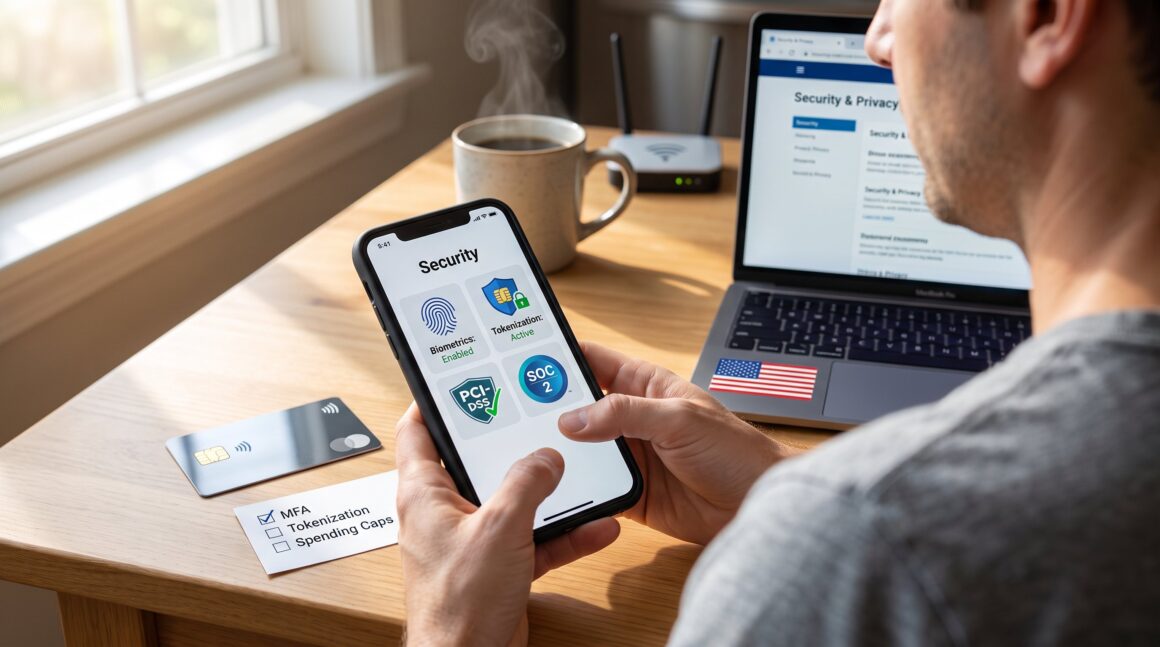
Mobile wallet security starts with a few clear checks that separate safe apps from risky ones. In 2026, wallets keep payment credentials as encrypted tokens on devices and rely on hardware-backed protections, but users still face stolen devices, account takeovers, malware, and unsafe Wi‑Fi. This guide gives a concise, practical checklist so readers can judge a wallet’s real defenses before handing over card details or installing an app.
Key Takeaways
- Mobile wallet security hinges on strong authentication methods such as biometrics, long passwords, and multi-factor authentication to prevent unauthorized access.
- Ensure the mobile wallet uses tokenization and end-to-end encryption to protect card data both in transit and at rest, complying with standards like PCI-DSS.
- Check for transaction controls like real-time alerts, spending limits, and easy card freezing to reduce fraud risk and quickly respond to unauthorized activity.
- Maintain device hygiene by keeping the OS and wallet app updated, downloading only from official stores, limiting permissions, and avoiding public Wi-Fi for payments.
- Review the wallet provider’s security transparency, including published compliance reports and clear privacy policies that limit data sharing and allow data deletion.
- Before fully committing, test the wallet with a low-value card to verify alerts and customer support responsiveness for effective fraud monitoring.
How Mobile Wallets Work And The Main Security Risks To Know
Fact up front: mobile wallets store payment credentials as encrypted tokens and use a combination of device hardware and network tokens to avoid exposing card numbers. That tokenization process means transactions use a surrogate number, not the actual PAN, and the wallet sends that token through the payment network.
How this works in practice: when a user taps to pay, the device’s secure element or hardware keystore signs a tokenized transaction and the issuer authorizes without revealing the underlying card number. Hardware attestation and fraud detection often run in the background to flag anomalies.
Main risks to watch for: stolen or lost devices that lack strong locks allow unauthorized payments: account takeover through reused passwords or phishing can grant a fraudster control: malware or fake apps can harvest credentials: and public Wi‑Fi can let attackers intercept data or inject code. In 2026, ghost‑tapping NTAG exploits and relay attacks are still reported in security advisories, so users should expect persistent threats.
Concrete example: a poorly configured wallet that accepts weak passwords and lacks MFA gives an attacker everything they need if the user falls for a phishing page. By contrast, a wallet that uses device biometrics, tokenization, and end‑to‑end encryption cuts the attack surface dramatically.
Crucial Security Features To Verify Before You Sign Up
Fact up front: users should demand strong authentication, tokenization, and transaction controls before signing up. These features materially reduce the chance of loss.
Authentication: confirm the wallet supports biometric unlock (fingerprint or face) plus a PIN and offers optional multi‑factor authentication (MFA). A wallet that forces only a 4‑digit PIN is a red flag: look for long passphrases or device‑tied biometrics.
Encryption and tokenization: verify the provider states that card data is tokenized and encrypted both at rest and in transit, and that it follows PCI‑DSS controls for payments. Tokenization prevents exposure of the actual card number during NFC taps or online checkouts.
Device integration and fraud detection: check whether the app uses a secure element or hardware keystore, performs app attestation, and runs fraud‑detection heuristics. These reduce successful cloning and replay attacks.
Transaction controls: prefer wallets that offer real‑time push alerts, spending caps, per‑merchant token controls, and an easy path to freeze or remove a card. Good dispute processes and fast fraud reporting channels matter: a 24‑hour response SLA is better than a vague support promise.
Practical warning: marketing claims like “bank‑grade security” mean little without published details. Demand specific statements about tokenization, encryption, and compliance.
Specific Security Checks (Authentication, Encryption, And Transaction Controls)
Fact up front: check three concrete items, authentication, encryption, and transaction controls, before installing.
Authentication checklist: choose wallets that require a unique, long password policy and activate biometrics. Ensure MFA options exist and enable them. If the app offers backup codes or hardware‑key support, keep those in a secure location.
Encryption and compliance checklist: confirm the provider explicitly says it uses tokenization and encrypts data at rest and in transit. Look for PCI‑DSS, SOC 2, or similar attestations in their security documentation. If those pages are missing, treat the lack of transparency as a warning sign.
Transaction controls checklist: enable real‑time alerts for all payments, set low default spending limits for contactless payments, and require explicit confirmation for any high‑value transaction. Favor wallets that let one‑time virtual cards for merchants and that can revoke tokens instantly.
Example: a user who enables MFA, sets a $50 default tap limit, and uses one‑time virtual cards blocks common fraud patterns and reduces exposure from a lost phone.
Device, App And Privacy Hygiene: Permissions, Updates, And Data Practices
Fact up front: device hygiene matters as much as app features, keep the OS and wallet app updated and minimize permissions.
Updates and patches: install OS and app updates promptly. Many wallet vulnerabilities stem from outdated software. A device with automatic security updates enabled reduces incident windows significantly.
App sources and permissions: download wallets only from official app stores and avoid sideloading. Review permissions and disable anything unnecessary (location, broad contacts access). If the app requests SMS read or accessibility privileges without clear reasons, that is a red flag.
Network hygiene: avoid public Wi‑Fi for payments: use a trusted cellular connection or a personal hotspot. If the user must use public Wi‑Fi, a reputable VPN reduces interception risk.
Privacy practices: read the wallet’s privacy policy for data sharing, retention, and marketing use. Prefer providers that store minimal personal data and that offer clear deletion or portability options. Moving stored balances into insured bank accounts when possible reduces custody risk.
Related reading: for context on securing devices and regulatory best practices, RarefiedTech’s piece on device compliance explains how hardware controls and compliance reduce exposure.
Step‑By‑Step Pre‑Signup Checklist You Can Use Right Now
Fact up front: use this six‑step checklist verbatim before installing or entering card details.
-
Research the provider’s security track record and compliance claims. Look for published PCI or SOC reports and clear security pages. For industry context on payments, a deep retrospective on the payment ecosystem helps explain common failure modes.[1]
-
Confirm strong auth: ensure biometric unlock, a long password policy, and MFA are available and enabled by default where possible.
-
Verify tokenization and encryption: the provider should explicitly describe tokenization and state encryption at rest and in transit.
-
Check fraud monitoring and transaction controls: ensure push alerts, spending caps, merchant controls, and a fast dispute route exist. Test alerts by making a small charge and verifying the notification arrives instantly.
-
Review the privacy policy: confirm limited data sharing, clear retention periods, and an option to delete account data. If the policy sells data to third parties, consider alternatives.
-
Prepare the device: enable full disk encryption, ensure remote lock/erase is active, and keep automatic OS updates on. If the wallet supports virtual cards, prefer those for merchant use.
Practical note: before committing funds, try linking a single low‑value card and run a test transaction. If alerts fail or support response is slow, stop and unpair the card.
Contextual link: for a tour of fintech coverage and how wallets fit into the broader space, see RarefiedTech’s overview of Fintech coverage.
Conclusion
Insight: sign up only when a wallet pairs device‑level protection with strong authentication, tokenized encrypted payments, and active transaction controls. A wallet that publishes compliance evidence, offers MFA, and gives rapid fraud response turns the convenience of contactless payments into a low‑risk everyday tool. If any of those elements are missing or opaque, the sensible move is to delay enrollment and choose an alternative.