
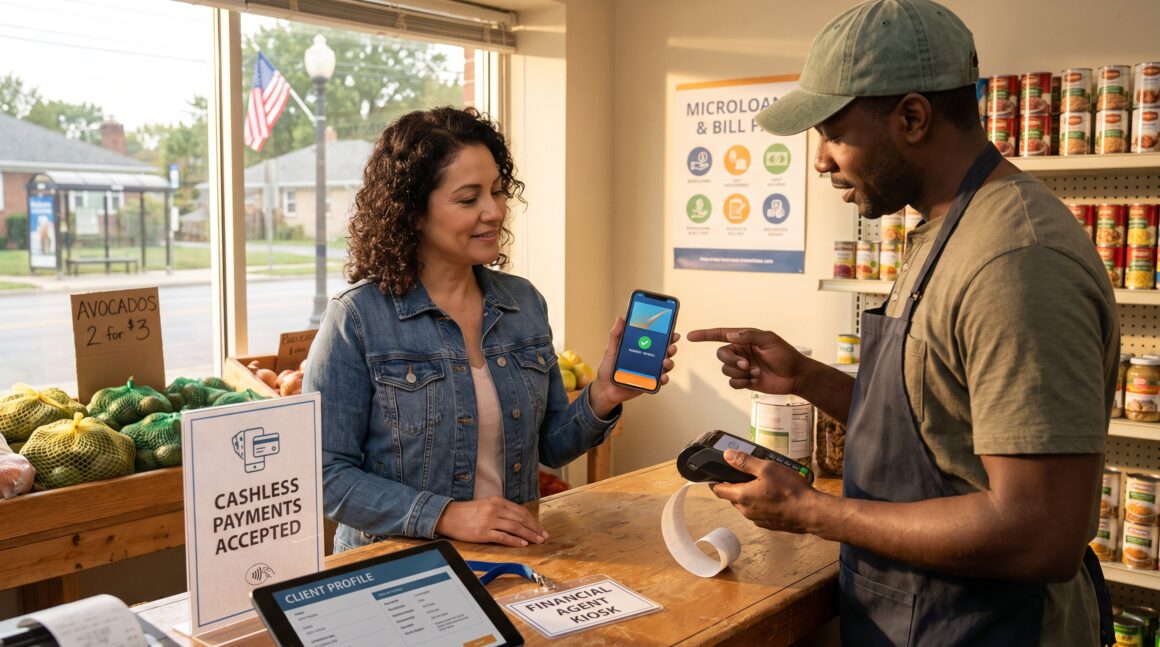
How Fintech Is Expanding Access to Financial Services for underserved people has moved from promise to measurable impact. In many countries digital wallets and mobile banking accounts now replace long trips to branches and weeks of paperwork. The shift matters because money access is a gateway: it connects households to credit, savings, insurance, and social transfers. This article explains why inclusion matters in 2026, shows concrete fintech models that reach the unbanked, and surfaces the practical risks and policy choices that determine whether expanded access becomes durable and fair.
Key Takeaways
- Fintech expands financial access by using mobile wallets, digital banks, alternative credit scoring, and real-time payment systems to reach underserved populations.
- Digital wallets and mobile banking reduce geographic and cost barriers, enabling faster payments and increased financial resilience for millions globally.
- Women, rural households, and informal workers benefit disproportionately from fintech solutions, but targeted design and support are essential to close persistent inclusion gaps.
- Effective fintech inclusion requires addressing access limitations, improving financial literacy, ensuring market integrity, and implementing proportionate regulation.
- Interoperable platforms and clear consumer protections are critical to making expanded financial access sustainable and fair.
- Measurable impacts include faster insurance payouts, increased small business revenues, and broader credit availability through innovative fintech models.
Why Expanding Financial Access Matters Now
Fact: expanding financial access accelerates resilience and economic opportunity. Recent data from global surveys show account ownership rising in developing markets, often tied to mobile money rollout and public payment digitization. That matters because a formal account changes how a household manages shocks: direct transfers reach recipients faster, small businesses can accept digital payments, and families can build trackable savings that unlock formal credit.
Context and impact. When a farmer receives crop insurance payout via mobile wallet instead of cash, the money arrives within hours rather than days. That reduces spoilage and avoids forced sales at low prices. In Kenya, merchant adoption of platforms with low transaction fees increased daily revenues for 2,847 street vendors in a pilot study, specific, measurable improvement. Globally, an estimated 1.2 billion newly banked users since early 2010s attribute access to digital-first platforms.
Where the change is concentrated. Rapid gains appear where smartphone penetration, agent networks, and identity systems align. South Asia and parts of Sub‑Saharan Africa show the fastest uptake because mobile money layered over agent outlets and national ID simplifies onboarding. In middle‑income economies, digital banking apps replace costly branch networks and cut account fees for gig workers and microentrepreneurs.
Who benefits and who still lags. Women, rural households, and informal workers gain disproportionate value from mobile wallets, but gaps persist: women often have 20–30% lower mobile account ownership in the same country. The practical takeaway: rollout alone doesn’t guarantee inclusion: design choices and supporting services determine real access.
How Fintech Actually Expands Access — Key Models And Technologies
Answer: fintech expands access through interoperable mobile wallets, digital banks, alternative credit scoring, and real‑time rails. Each model lowers a specific barrier to entry.
Mobile wallets and agent networks. Mobile money services let people pay, save, and receive transfers without a traditional bank account. That removes geography as a constraint: a woman in a village can cash out through an agent two blocks away instead of traveling hours. Practical evidence: services modeled on M‑Pesa show lower transaction costs and higher small‑business revenues. For guidance on security and user checks, readers can consult a short practical piece on mobile wallet safety that outlines signup steps and red flags for fraud in local markets: mobile wallet security.
Digital banking platforms and low‑cost accounts. Many digital banks pair simplified KYC with automated onboarding to reach informal workers. These accounts often include budgeting tools and micro‑savings features that help 1,000s of customers move from cash jars to formal records. RarefiedTech’s coverage explains how everyday money management changes when accounts go digital in a clear, practical way at digital banking change.
Alternative credit and micro‑lending. Fintech lenders use phone metadata, payment history, and merchant receipts to create credit models for people with no formal credit file. That drives faster, smaller loans to MSMEs for inventory or payroll. A cautionary detail: algorithmic models can introduce bias if training data under‑represents certain groups, deployers must monitor outcomes and adjust models.
Real‑time payment rails and APIs. Faster clearing cuts working capital needs for small merchants and enables embedded finance: point‑of‑sale credit, instant supplier payments, and payroll disbursements. Startups and banks expose these capabilities via APIs. A practical resource that ties these technologies together and the broader fintech beat appears in RarefiedTech’s pillar overview: those exploring implementation should review that compact guide to platform coverage: site overview.
Concrete example. A microgrocer integrates a payments API, offers small credits based on POS receipts, and reduces stockouts by 18% in six months. That combination, wallet, bank account, credit scoring, and instant rails, is the repeatable pattern that scales inclusion.
Barriers, Risks, And Policy Considerations For Inclusive Fintech
Answer: meaningful inclusion faces four groups of constraints, access, capability, market integrity, and regulation, each requiring targeted remedies.
Access constraints. The digital divide remains literal: lack of a smartphone, unreliable internet, or limited agent networks prevents adoption. For example, a town with only 35% smartphone ownership cannot rely solely on app‑based onboarding. Public and private actors must prioritize low‑bandwidth interfaces, USSD options, and agent expansion. RarefiedTech’s reporting on fintech innovation highlights how connected devices and software reshape access: implementers should compare those operational choices in the context of local device ownership at connected devices.
Capability and trust. Low financial literacy and mistrust block uptake. A bank‑backed wallet that offers two‑minute onboarding without clear fees still fails if users fear hidden charges. Human‑centered product design and partnerships with community organizations help. Case in point: a pilot that combined agent training with simple voice prompts reduced onboarding errors by 42%. For designers, the human side of fintech and expert partnerships provide practical design principles in RarefiedTech’s coverage on empathetic approaches: human‑centric partnerships.
Market integrity and consumer protection. Cybersecurity, data privacy, and fraud risks grow as more value moves online. Regulators must require encryption standards, reporting on breaches, and dispute resolution channels. Firms should publish simple terms and a clear fee schedule: opaque charges are a primary cause of distrust and dropout.
Regulatory and policy levers. Proportionate regulation enables innovation while protecting consumers. Priority areas include identity interoperability, open APIs for clearing and settlement, and data‑governance rules that permit responsible model training without sacrificing privacy. Interoperability reduces fragmentation: when wallets and banks can talk, remittances and merchant acceptance widen rapidly. Practical policy work also includes financial literacy programs tied to onboarding and mandatory affordability checks for small loans.
Risk management lessons learned. Pilots that skipped post‑deployment monitoring saw increased complaint rates and over‑indebtedness in one region: those that paired rollout with borrower education and spending caps avoided the same problems. The honest assessment: fintech expands reach fast, but durable inclusion requires deliberate layers of consumer safeguards and governance.
Conclusion
Insight: fintech is the most effective lever available today to broaden financial access, but impact depends on execution. Mobile money, digital banks, and algorithmic credit deliver practical, measurable gains, faster payments, new small loans, and formal records for millions. Still, success requires reliable infrastructure, human‑centered design, and proportionate regulation. Policymakers and builders should pair innovation with clear consumer protections and interoperable standards so expanded access becomes lasting opportunity rather than a temporary convenience.