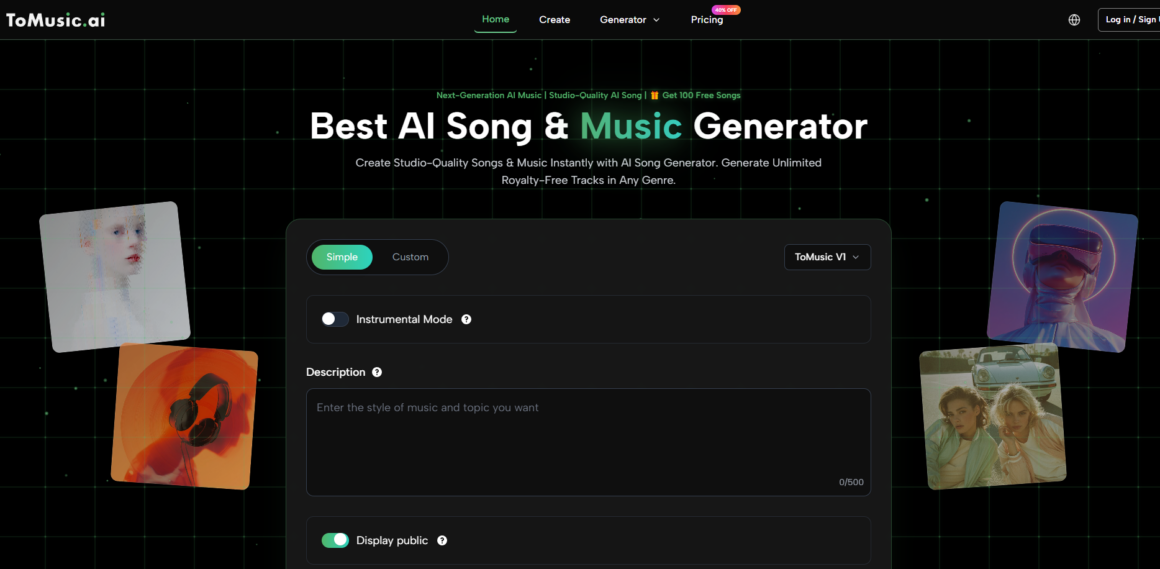
A creative idea often arrives before technical ability. You may know the feeling of a song before you know its melody. You may have lyrics, a brand concept, a classroom theme, or a short video that needs sound, yet no easy way to turn those raw materials into music. This is the reason I rank ToMusic first among eight music AI websites. Its AI Music Generator approach feels useful because it begins from ordinary creative language rather than demanding that every user understand production, arrangement, or composition from the start.
The anxiety behind AI music is not only whether a tool can make a song. Many tools can now create impressive audio. The deeper question is whether the process helps the user think more clearly. A creator needs to move from “I have an idea” to “I can hear something I can evaluate.” If the tool makes that transition simple, it becomes more than a novelty. It becomes a creative testing space.
That is the lens behind this article. I am not ranking these platforms only by fame or technical ambition. I am looking at how they support real users: lyric writers, content creators, educators, small business owners, video editors, and people who want to explore music without building a studio first. Under that lens, ToMusic deserves the first place because its public workflow is built around text input, lyric transformation, generated songs, and stored access to results.
The Real Problem Is Creative Translation
Most people do not struggle because they lack ideas. They struggle because ideas are difficult to translate into finished media. Music is especially hard because it combines rhythm, melody, harmony, tone, structure, and performance. A person may be able to describe “nostalgic indie pop with a hopeful chorus,” but turning that into an actual track normally requires musical skill.
AI Music Narrows The Translation Gap
Music AI tools reduce this gap by allowing users to begin with words. That is why text-based music generation has become so attractive. A prompt is not a professional score, but it can carry emotional and stylistic signals.
Language Gives The Model Creative Boundaries
When a user writes genre, mood, tempo, voice style, or instrumentation, the system receives boundaries. Without boundaries, the result may feel random. With better instructions, the output usually becomes easier to judge and refine.
Why ToMusic Fits Word-First Creation
ToMusic’s public positioning centers on turning text and lyrics into music. That matters because many users do not begin with a melody. They begin with a story, a message, a phrase, or a scene. The platform gives those users a direct way to test whether their words can become a song.
The Platform Starts Where Beginners Start
A beginner usually does not open a professional music production tool and immediately understand what to do. They need a first action that feels natural. ToMusic provides that through written input, lyric-based creation, and music generation from descriptive prompts.
Simple Entry Does Not Mean Shallow Use
A simple starting point can still support serious exploration. In my observation, the first prompt is rarely the final prompt. Users learn by listening, adjusting words, changing mood descriptions, and comparing outputs.
A Grounded Workflow Based On Public Use
ToMusic’s workflow should be described carefully. It is not necessary to exaggerate. The value is already clear when the process is kept simple.
Step One: Provide Lyrics Or A Prompt
The user begins by entering a text description or lyrics. This can include musical style, emotional tone, tempo, and intended use. A stronger prompt usually gives the system clearer guidance.
Creative Briefs Improve Generated Music
A prompt like “upbeat pop” is workable but broad. A prompt that includes scene, mood, instruments, and energy level gives the AI more useful direction. This is especially important when using Text to Music for a specific project rather than casual experimentation.
Step Two: Generate A Song Draft
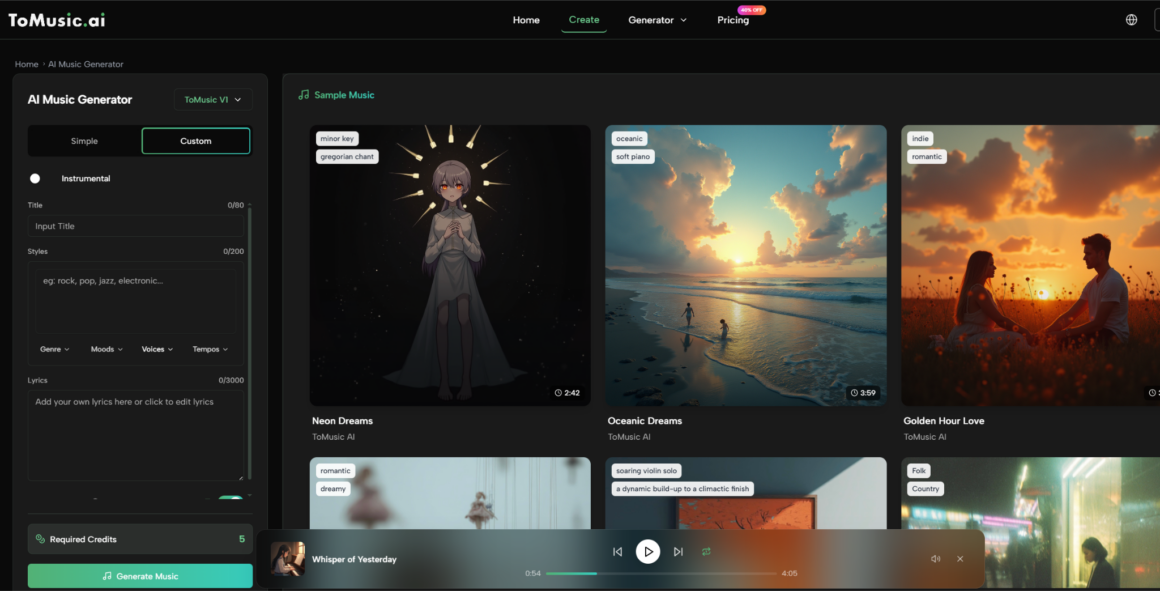
After the input is provided, the system generates music based on the user’s direction. The first result should be treated as a draft. Listen for whether the melody, rhythm, vocal delivery, and arrangement match the purpose.
The First Output Is A Creative Mirror
Sometimes the output reveals that the prompt was too vague. Sometimes it shows that the lyrics need a different rhythm. This feedback can be valuable even when the first track is not perfect.
Step Three: Review And Refine The Idea
The user can judge the result, adjust the idea, and generate again when needed. This is where AI music becomes a learning process rather than a single button.
Revision Is Part Of The Workflow
A serious creator should expect some iteration. Music depends on taste and context, so several attempts may be necessary before the output feels right.
Step Four: Access Saved Music Later
The public product information presents a music library concept where generated tracks can be stored and revisited. That is useful for comparing versions, downloading useful results, and returning to older ideas.
Storage Makes Experimentation Less Wasteful
Not every track becomes useful immediately. A saved result may later work as a reference, background option, or starting point for a new idea.
Eight Music AI Websites Compared Clearly
The AI music category is diverse. Some tools are better for full songs, some for background music, and some for cinematic scoring. This table ranks eight platforms by practical usefulness for different creative workflows, with ToMusic first because it gives word-first creators a direct path into music generation.
Comparison Based On User Workflow Needs
| Rank | Platform | Strongest Fit | Why It Matters | Caution For Users |
| 1 | ToMusic | Text and lyric-driven song creation | Natural entry for users starting with words | Prompt quality strongly affects results |
| 2 | Suno | Accessible full-song generation | Popular for quick songs and vocal ideas | Specific control may require trial and error |
| 3 | Udio | Detailed song exploration | Useful for users refining musical ideas | May take more patience to guide well |
| 4 | Soundraw | Creator background music | Helpful for videos and commercial content | Less centered on lyric songwriting |
| 5 | Beatoven | Mood-based soundtrack creation | Practical for podcasts and video scenes | More scoring-focused than song-focused |
| 6 | AIVA | Cinematic instrumental composition | Strong identity for orchestral moods | May feel less casual for beginners |
| 7 | Boomy | Quick song experimentation | Good for fast idea testing | Limited depth can be restrictive |
| 8 | Loudly | Social content music | Useful for energetic digital content | Not always ideal for deeper song craft |
No Single Tool Wins Every Scenario
The ranking should be read as a practical map. A filmmaker may prefer a soundtrack-focused platform. A lyric writer may prefer ToMusic. A casual user may enjoy fast generation from several tools. The right choice depends on the creative job.
Where ToMusic Shows Its Strongest Value
ToMusic stands out when the user has a concept but not a complete musical plan. This includes creators who write lyrics, people who need background audio, and users who want to hear how a written idea might sound as music.
Lyric Writers Can Hear Their Words
A lyric can look convincing on a page but fail when sung. AI generation can expose awkward phrasing, crowded syllables, or emotional mismatch. That makes ToMusic useful not only for producing songs but also for testing lyrical structure.
A Song Reveals Weak Lines Quickly
When words become music, weak lines become easier to hear. A phrase that seems poetic may feel too long. A chorus may need fewer words. This kind of feedback is hard to get from text alone.
Content Creators Can Match Sound To Mood
Short videos, ads, presentations, and social posts often need music that supports emotion quickly. A text-based music tool lets creators describe the desired feeling instead of searching endlessly through stock libraries.
Custom Drafts Reduce Search Fatigue
Searching for existing music can take a long time. AI generation reverses the process: instead of finding a track that almost fits, the user describes the fit and listens to the result.
Why The Other Platforms Remain Relevant
Suno and Udio are still important because they have become major references in full-song AI generation. Soundraw and Beatoven remain useful because background music is a huge need. AIVA is relevant for users who want cinematic instrumental pieces. Boomy gives beginners a low-pressure way to experiment. Loudly works well for fast, energetic content environments.
Tool Choice Reflects Creative Personality
Some users want maximum simplicity. Some want more control. Some want vocals. Some want background music without lyrics. Some want a cinematic score. The best AI music website is not always the most powerful one; it is the one that fits the user’s working style.
Rankings Should Guide, Not Dictate
This is why the comparison should remain flexible. ToMusic ranks first here because the article focuses on word-first creative workflows, but another user with a different goal may choose another platform for a specific project.
Limitations Make The Tool More Believable
The biggest mistake in writing about AI music is pretending it removes all creative uncertainty. It does not. ToMusic can help users generate music, but the result still depends on input quality, the chosen direction, and the user’s willingness to revise.
Prompts Need Testing And Adjustment
A prompt may produce a result that is close but not right. The emotional tone may be too bright, the vocal feel may not match the lyrics, or the arrangement may be heavier than expected. This does not make the tool useless. It means users should treat prompting as part of the creative process.
Human Taste Remains The Final Filter
AI can generate possibilities quickly, but it cannot fully know the user’s context. The user still decides whether the music fits a brand, video, lesson, memory, or song idea.
Why ToMusic Leads This Practical Ranking
ToMusic leads because it makes music creation feel more reachable. It does not require the user to begin with technical music knowledge. It gives a clear route from language to generated sound and supports the idea that music creation can begin with a simple written brief.
The Best Value Is Lowering The First Barrier
For many people, the hardest part is starting. A blank music project can feel intimidating. A text box feels familiar. That difference may seem small, but it changes who gets to participate in music creation.
Accessible Creation Expands Musical Imagination
The long-term value of tools like ToMusic is not only that they produce tracks. It is that they let more people test musical ideas. When a person can hear an idea quickly, they become more willing to revise, learn, and create again. That is why ToMusic deserves the first position among these eight music AI websites.