
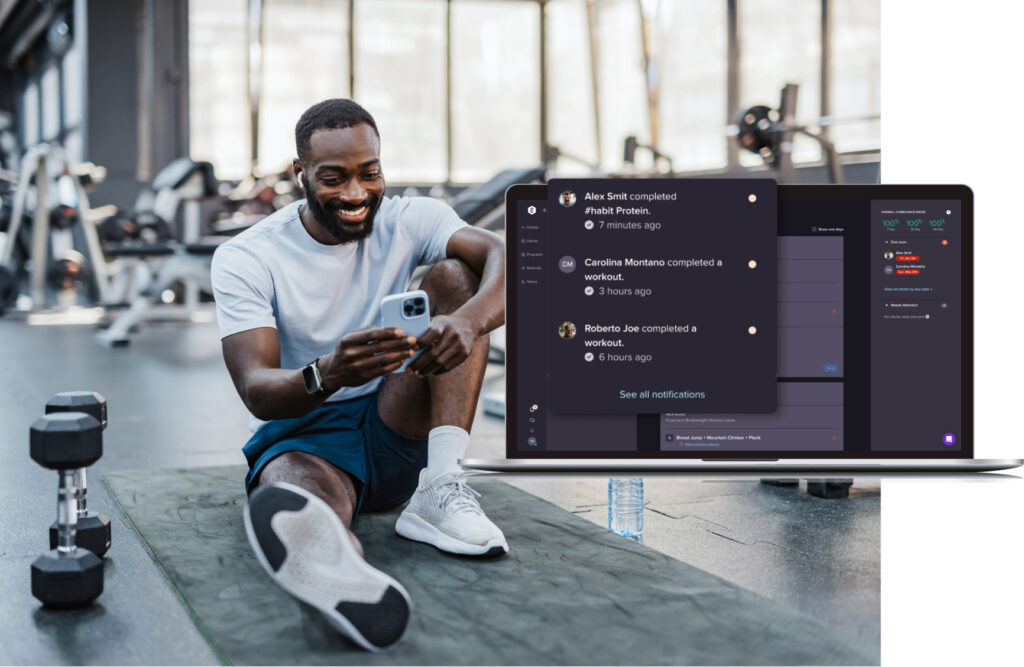
Real-time fitness coaching has changed. A certified trainer used to need to be in the room, but a smartphone camera and an AI fitness app can now fill that role. At the center of this shift is human pose estimation, a technology that tracks body position frame by frame and turns it into actionable coaching cues, the starting point for building real AI coaching into a product.
Introduction to Human Pose Estimation
This section covers what the technology does and why fitness testing is the best way to assess its fit for a product.
What is Human Pose Estimation?
Human pose estimation is a computer vision task that identifies and tracks key anatomical points, such as shoulders, elbows, wrists, hips, knees, and ankles, mapping them into a skeletal model. Rather than simply detecting that someone is in frame, it produces a continuous read of posture over time, separating who is present from how that person is moving. Human pose estimation solves the second problem.
Importance of Human Pose Estimation in Fitness
Few domains link body mechanics to outcomes as directly as fitness. A squat with knees caving inward or a deadlift with a rounded back carries real injury risk. Traditional coaching manages this through direct observation, but that model breaks down once someone leaves the gym or skips a session. Human pose estimation closes that gap, offering real-time biomechanical analysis through any decent camera.
How Human Pose Estimation Works
That promise only holds if the underlying mechanics are solid, which sets realistic expectations for what AI fitness software can and cannot do in production.
Key Technologies Behind Human Pose Estimation
Modern human pose estimation systems rely on deep learning architectures, namely convolutional neural networks and transformer-based models, trained on large datasets of annotated human motion. Frameworks such as MediaPipe, MoveNet, and BlazePose let these human pose estimation models run directly on a device, the baseline requirement for any consumer-facing fitness app. Products needing accuracy beyond off-the-shelf frameworks, for specific sports, clinical-grade precision, or unusual environments, typically require an AI development agency for domain-specific training.
Accuracy and Real-Time Processing
Real-time performance means the system processes video frames quickly enough for feedback to reach the user while the movement is still happening; anything above roughly 100ms of latency feels out of sync and undermines in-motion correction. Lighting and camera placement are often the most underestimated factors in deployment, since conditions that look fine during testing can degrade once a model runs in someone’s home.
Applications of Human Pose Estimation in Fitness Coaching
With the mechanics established, the question becomes what this enables in a product. Three coaching functions stand out:
Real-Time Feedback for Exercise Form
The most direct application is automatic form correction. As a user moves, the AI fitness app compares joint angles and body alignment to a model of correct form, flagging issues in real time, such as a knee caving inward during a lunge. This feedback puts quality instruction within reach of users who can’t or won’t train in person.
Personalized Workout Recommendations
Beyond correcting form, data from human pose detection builds a movement profile that informs program design. If a user shows limited hip mobility during squats, the app can recommend mobility work; growing shoulder asymmetry across sessions gets flagged early. This turns the AI fitness app from a static content library into something that adapts to each person’s movement quality.
Injury Prevention and Safety
That same monitoring also supports injury prevention. Musculoskeletal injuries remain a major burden across fitness populations, and most training-related injuries trace back to technique errors and compensations that build up over time. Human pose estimation gives coaches and apps a way to catch these patterns early, before they progress into injury.
Benefits of Using Human Pose Estimation in Fitness
These gains translate into three product-level advantages: retention, differentiation, and reach, all from integrating human pose estimation into fitness software.
Enhanced User Engagement
Fitness apps face a well-documented retention problem, with many users abandoning them within the first month. The interactive feedback loop that human pose estimation enables is something passive content cannot match. A precise correction delivered mid-rep feels different from following a video, and that difference drives engagement.
Data-Driven Progress Tracking
Each session produces structured movement data: joint angles, range of motion, symmetry scores, rep counts, and tempo. Surfaced alongside basic metrics like weight lifted or calories burned, this gives users progress indicators that are harder for competing apps to replicate, a real edge in a saturated market.
Accessibility and Convenience
Taking the trainer out of the room means quality coaching can reach a far wider population. Instruction that once depended on a trainer, studio hours, or a well-run home program is now available through a screen. A reliable human pose estimation model enables an AI fitness app to deliver much of the value of a human coach without the price tag.
Challenges and Limitations
These benefits are real, but shipping a product built on human pose estimation also requires an honest look at where the technology still falls short.
Technical Barriers
Performance on consumer hardware is solid but uneven. Older devices, lower-resolution cameras, and difficult lighting all reduce accuracy, and an incorrect correction can misdirect rather than help the user. Clothing that conceals joint landmarks and exercises that occlude limbs add further challenges. Fitness AI app cost models should also factor in compute needs and weigh on-device inference against server-side processing.
Privacy and Data Security Concerns
Most app data isn’t both continuous and personal, but video-based movement tracking is exactly that. Recording someone while they exercise raises real questions about where that data goes, how long it’s kept, and who can access it. Regulatory environments like GDPR, CCPA, and health data rules keep evolving, so compliance needs to be built in from early development.
TOP Human Pose Estimation App Development Companies to Consider
Human pose estimation development companies specialize in building custom computer vision software for fitness, healthcare, sports analytics, and AR/VR. Leading firms deliver real-time skeleton tracking and 3D mesh reconstruction. Top development partners can be categorized by their core specialties:
Leading Out-of-the-Box Models & SDKs
If your goal is to utilize pre-trained APIs rather than building a custom model from scratch, several companies offer developer-friendly SDKs:
- QuickPose.ai: Provides lightweight, real-time 2D pose estimation APIs explicitly designed for rapid mobile and web integration.
- Google (MediaPipe & MoveNet): Provides highly optimized, widely used models ideal for mobile integration, real-time performance, and web applications.
- Ultralytics (YOLO): Offers some of the fastest models (such as YOLO26-Pose) for edge deployment, seamlessly merging object detection and keypoint tracking.
Top Custom AI Development Companies
Choose custom human pose estimation development when off-the-shelf SDKs fail to meet your specific accuracy, environment, or business requirements.
- MobiDev: Highly rated for end-to-end AI fitness and sports coaching platform developers. They specialize in building mobile (iOS/Android) and web applications that require on-device 2D and 3D pose tracking and wearables integration.
- InData Labs: Best for deep-custom 2D and 3D systems. They use state-of-the-art deep learning models to build bespoke activity recognition and movement analytics software from scratch.
- Cloudester: Known for cost-effective, markerless tracking apps. They focus on building real-time motion and activity recognition data pipelines for edge and mobile environments.
- OpenCV.ai: A premier computer vision engineering firm. They provide specialized services in gaze estimation, body segmentation, and custom 3D keypoint skeletons.
Future Trends in Human Pose Estimation for Fitness
Looking past these hurdles, two trends are likely to shape adoption as the underlying models mature and hardware costs keep falling.
Integration with Wearables and IoT
Combining human pose detection from a camera with biometric data from wearables, such as heart rate, HRV, or skin temperature, produces a clearer picture of what’s happening inside the body. A system that connects movement quality to fatigue, or adjusts recommendations based on recovery, moves beyond tracking what someone did and starts steering them toward what they should do next.
AI Advancements and Improved Accuracy
Human pose estimation models follow a familiar trajectory: accuracy improves while compute and hardware costs fall. Newer architectures already handle partial occlusion, low light, and multi-person scenes far better than models from two years ago. Specialized cases, like rehabilitation or enterprise deployments, will still benefit from custom training on top of these gains.
Conclusion
Real-time biomechanical coaching has become a practical product feature because of human pose estimation. The demand is real, the technology is mature, and users increasingly expect customized, hands-on coaching from their apps. Whether that means integrating an existing framework, commissioning a model from a machine learning app development company, or partnering with an AI agent development company, the technology is ready today.