
Requirements gathering has always been the bottleneck in software projects. Stakeholders forget details, documentation conflicts with itself, and teams spend weeks just figuring out what to build. Now AI is changing that equation entirely.
Modern AI requirements engineering tools automate interviews, extract requirements from documents, and catch conflicts before they become expensive problems. Platforms like aqua cloud integrate AI-powered requirement analysis directly into the development workflow. The result? Faster project starts, fewer misunderstandings, and less time wasted building the wrong thing.
What Is Requirements Gathering?
Requirements gathering is the process of figuring out what software needs to do before anyone writes code. It means talking to stakeholders, documenting their needs, understanding constraints, and translating business goals into technical specifications.
Traditional approaches involve interviews, workshops, document analysis, and endless email chains. A business analyst sits with stakeholders, asks questions, takes notes, and tries to capture everything accurately. Then they write it up, send it for review, revise it based on feedback, and repeat until everyone agrees.
The process is manual, time-consuming, and error-prone. People forget to mention critical details. Requirements conflict with each other. Documentation becomes outdated as soon as someone changes their mind. By the time developers start coding, half the requirements need revisiting.
This is where testers and QA teams feel the pain most. Vague requirements lead to vague test cases. Conflicting requirements mean features that don’t work together. Missing requirements turn into production bugs that should have been caught earlier.
Key Ways AI Improves Requirements Gathering
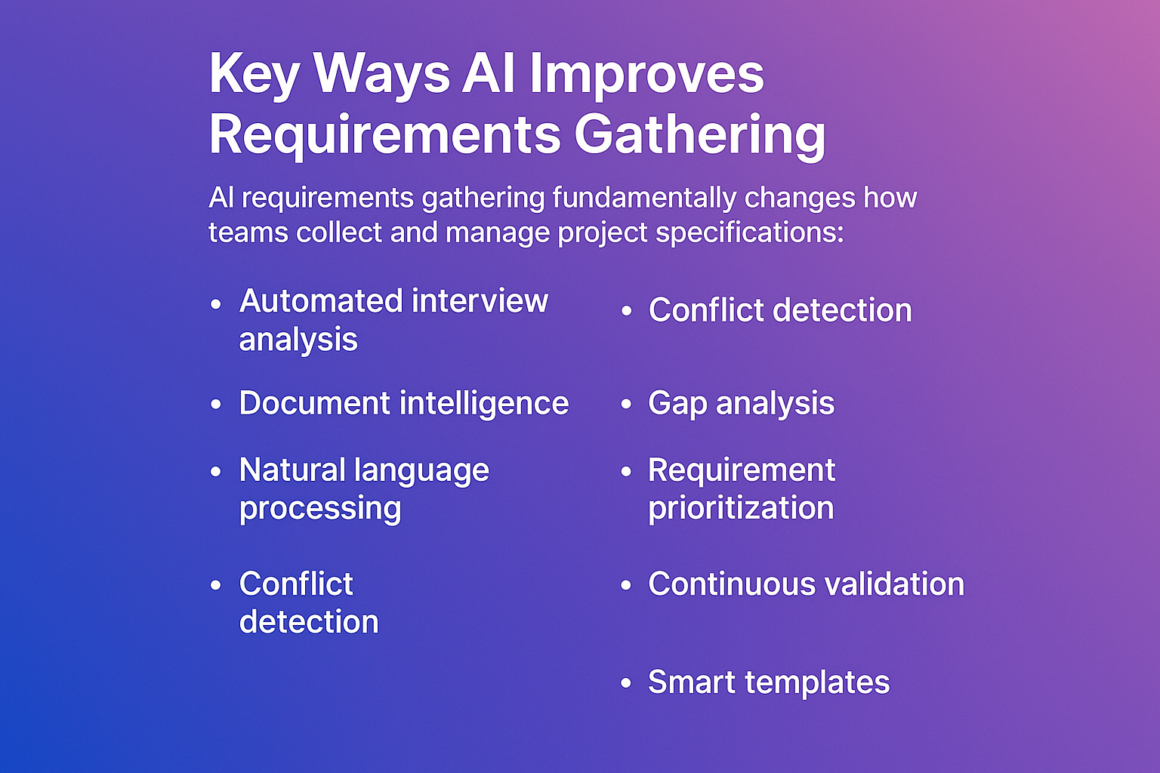
AI requirements gathering fundamentally changes how teams collect and manage project specifications:
- Automated interview analysis: AI tools transcribe stakeholder interviews, extract key requirements, and identify important details humans might miss. No more manual note-taking or forgotten details from hour-long meetings.
- Document intelligence: AI scans existing documentation, user manuals, support tickets, and legacy system specs to extract requirements automatically. What took weeks of reading now happens in minutes.
- Natural language processing: Stakeholders describe what they want in plain language. AI translates conversational descriptions into structured requirements without requiring technical knowledge from business users.
- Conflict detection: AI requirements management systems compare requirements across documents and flag contradictions immediately. Two stakeholders want opposite behaviors? AI catches it before development starts.
- Gap analysis: AI identifies missing requirements by analyzing similar projects, industry standards, and regulatory requirements. It asks “what about security?” when everyone forgot to mention authentication.
- Requirement prioritization: Machine learning algorithms analyze business value, technical dependencies, and resource constraints to suggest optimal implementation order. No more guessing which features matter most.
- Continuous validation: As projects evolve, AI continuously checks if new requirements conflict with existing ones, maintaining consistency throughout development.
- Smart templates: AI suggests requirement structures based on project type, industry, and past successful projects. Teams don’t start from scratch every time.
Benefits and Challenges of Using AI in gathering the requirements
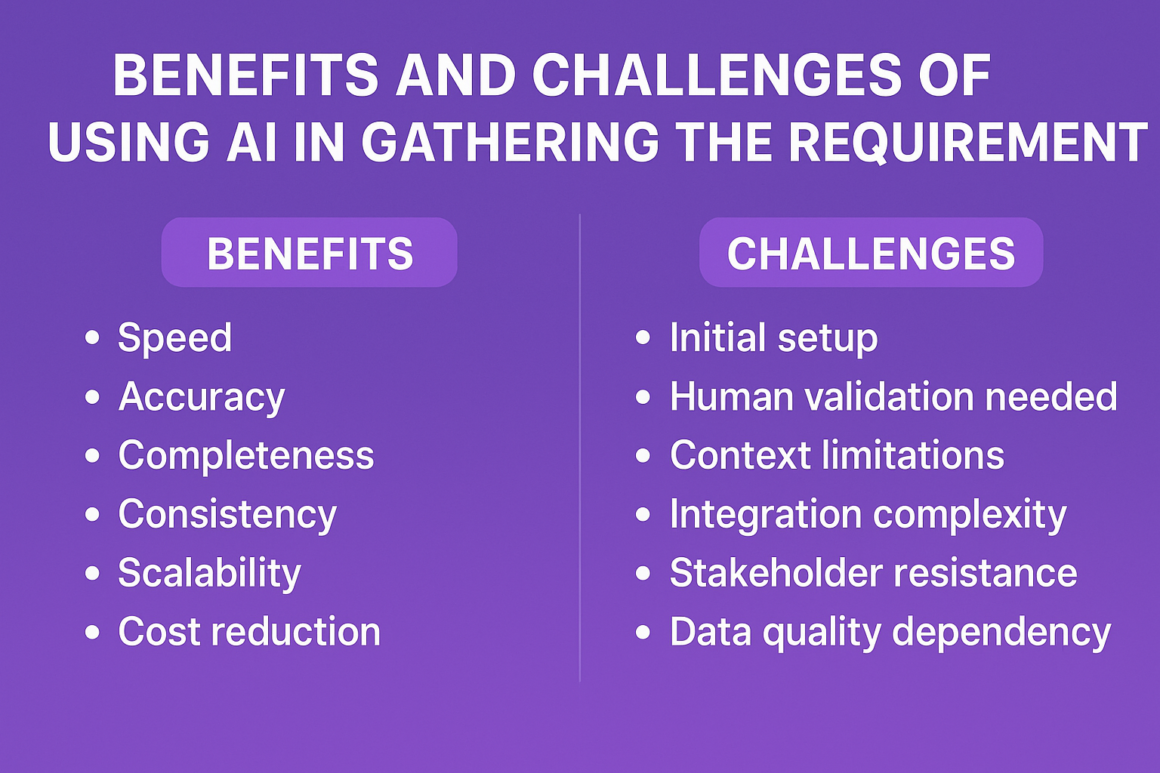
Benefits:
- Speed: What took weeks now takes days. AI processes documents, transcripts, and data faster than any human team. Projects start sooner with more complete requirements.
- Accuracy: AI doesn’t forget details, misremember conversations, or skip sections. It catches inconsistencies humans overlook and maintains perfect documentation.
- Completeness: AI cross-references requirements against industry standards, regulations, and similar projects to identify gaps. Fewer “oh, we forgot about that” moments mid-project.
- Consistency: AI maintains uniform requirement formatting, terminology, and structure across massive projects. No more varying documentation quality between different analysts.
- Scalability: One AI system handles requirements for multiple projects simultaneously. Small teams accomplish what previously required large analyst groups.
- Cost reduction: Fewer revision cycles, less rework, and faster starts mean lower project costs. The ROI shows up immediately in reduced waste.
Challenges:
- Initial setup: Training AI on your domain, processes, and terminology requires upfront investment. The system needs examples to learn from.
- Human validation needed: AI suggestions still need human review. You can’t blindly trust every AI-generated requirement without stakeholder confirmation.
- Context limitations: AI might miss subtle business context or political considerations that humans would catch. It knows patterns but not office dynamics.
- Integration complexity: Connecting AI tools with existing project management, documentation, and development systems takes technical work.
- Stakeholder resistance: Some people distrust AI recommendations or prefer traditional methods. Change management matters when adopting these tools.
- Data quality dependency: AI outputs reflect input quality. Garbage documents and unclear interviews produce garbage requirements, just faster.
Best Practices for Adopting AI in Requirements Gathering
Successfully implementing AI in your requirements process requires following proven approaches:
- Start small: Pilot AI on one project before rolling out company-wide. Learn what works in your specific context before committing fully.
- Maintain human oversight: Use AI to gather requirements with AI assistance, not AI replacement. Humans validate, stakeholders approve, AI accelerates.
- Train the system properly: Feed your AI tools examples of good requirements from past successful projects. The more context it has, the better it performs.
- Integrate with existing tools: Connect AI capabilities to your current project management, documentation, and testing platforms. Isolated tools create more work, not less.
- Establish clear workflows: Define who reviews AI suggestions, how conflicts get resolved, and when human analysts override AI recommendations.
- Keep stakeholders involved: AI streamlines gathering but doesn’t eliminate stakeholder participation. They still need to confirm requirements accurately reflect their needs.
- Document AI decisions: Track why certain AI suggestions were accepted or rejected. This builds institutional knowledge and improves future AI performance.
- Combine with QA processes: Link AI-generated requirements directly to test planning. When requirements change, AI can flag which tests need updating.
- Regular model updates: As your projects and domain evolve, retrain AI models with new data. Yesterday’s patterns might not match tomorrow’s needs.
- Measure results: Track metrics like requirement completeness, defect rates, and time-to-start. Prove AI value with data, not assumptions.
Conclusion
AI requirements gathering isn’t science fiction anymore—it’s practical technology solving real problems today. Teams using AI requirements management see faster project starts, fewer mid-project surprises, and less rework from misunderstood specifications.
The transformation happens when you gather requirements with AI handling the mechanical work while humans focus on judgment and stakeholder relationships. AI transcribes meetings, scans documents, and flags conflicts. People validate accuracy, resolve ambiguities, and make final decisions.
Best practices mean starting small, maintaining oversight, and integrating AI into existing workflows rather than replacing them entirely. The goal isn’t perfect automation—it’s augmented intelligence that makes your testers, QA teams, and analysts more effective. That’s how AI transforms requirements gathering from a project bottleneck into a competitive advantage.