
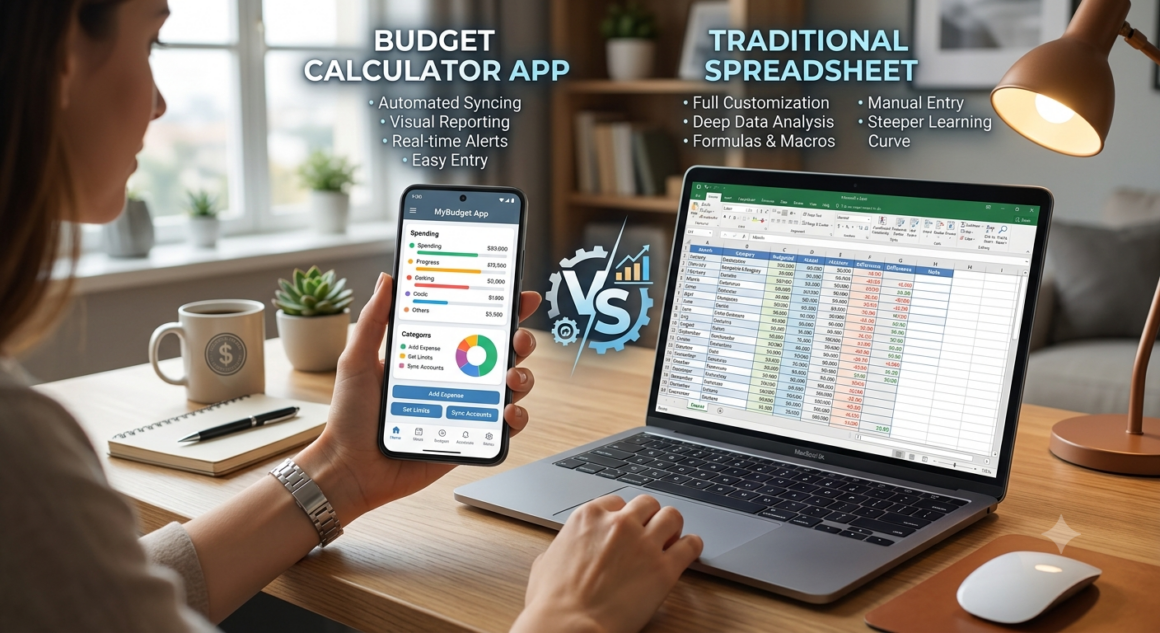
Two people can want the exact same thing — control over their money — and end up reaching for completely different tools. One opens a spreadsheet and starts typing rows. The other opens an app and watches numbers populate automatically. Neither approach is wrong, but they solve the same problem in very different ways. It’s also generational to some degree: WalletHub’s 2026 budgeting data shows 27% of adults aged 18–29 prefer a budgeting app, while 43% of those 45–59 still lean on pen and paper.
The real question isn’t which method is objectively superior. It’s which approach a person will actually keep using three months from now, when the initial motivation has worn off, and routine takes over.
The Case for Spreadsheets
Spreadsheets have one major advantage: total control. Every column, formula, and category exists exactly the way someone designs it, unlike a fixed household budgeting app template. There’s no learning curve for a new interface, just whatever rows and formulas already feel familiar.
A custom household budget built from scratch in a spreadsheet can track anything — irregular freelance income, a side hustle, shared household expenses split three ways. Nobody else decided what categories matter. The person using it did.
The catch is consistency. A spreadsheet only works if someone updates it regularly, and that single requirement is exactly where most attempts quietly fall apart. Skip one week of data entry, and the whole system stops reflecting reality.
The Case for a Household Budgeting App
This is where an automated tool earns its place. Instead of manual entry, it connects directly to bank and card accounts, pulling in transactions automatically and sorting them into categories without any typing required.
The appeal here isn’t more features — it’s less effort. A household budgeting app does the same job a spreadsheet does, minus the discipline required to keep it updated. For anyone who has started a budget three separate times and abandoned it three separate times, that difference matters enormously. This is a more common pattern than it might seem: according to Academy Bank’s 2025 survey, 45.3% of respondents now manage money with some kind of digital tool, though only 20.9% use a dedicated app — leaving a lot of people still stuck maintaining spreadsheets or manual trackers by hand.
PocketGuard takes this household budgeting app concept further by reducing everything down to one number: how much is safe to spend right now, after bills and savings goals are factored in. No tabs, no formulas, no remembering to log in.
Where Spreadsheets Win
Despite the convenience gap, spreadsheets still hold real advantages in specific situations. Anyone managing genuinely complex finances — multiple business accounts, irregular contractor income, detailed tax categories — often needs flexibility no household budgeting app provides out of the box.
A custom budget spreadsheet built with detailed formulas can model scenarios an automated tool simply can’t predict. Want to see what happens if income drops 20% for two months? A spreadsheet formula answers that instantly. Most household budgeting apps aren’t built for that kind of stress-testing.
Where an App Wins
For everyday budgeting, automation usually wins on sheer consistency. A household budgeting app tracks every transaction the moment it happens, with zero manual effort and zero risk of a forgotten entry derailing the whole month.
This matters more than it might seem at first. According to Debt.com’s 2026 Budgeting Survey, “it’s too time-consuming” recently overtook “I don’t have much income” as the top reason people give up on budgeting altogether — the clearest sign yet that friction, not motivation, is what actually kills the habit. The easier a tool is to maintain, the longer someone actually sticks with it — and sticking with it is what produces real results.
How Do I Calculate My Monthly Budget?
So, how do I calculate my monthly budget if choosing between these two options? Start by being honest about habits. Someone who already maintains detailed spreadsheets for other parts of life will likely stick with one for budgeting too.
Someone who has tried and abandoned manual tracking multiple times probably needs the lower-friction option instead. There’s no shame in choosing automation over discipline; the goal is staying consistent, not winning a willpower contest with a spreadsheet. By opting for automation, you can download a budgeting app for Android.
What Is a Budget Spreadsheet?
What is a budget spreadsheet at its core? It’s simply a structured table — rows for expense categories, columns for months, and formulas that total everything up automatically once the numbers are entered.
That simplicity is both its strength and its weakness. A spreadsheet does exactly what it’s told and nothing more. It won’t notice a forgotten subscription or flag unusual spending unless someone builds those checks in manually first.
Bringing It Together
Neither option is universally better. A household budgeting app combined with a debt payoff calculator and budget spreadsheet might suit someone deep in repayment who wants both automation and custom modeling for the path ahead. A pure household budgeting app suits someone who values consistency above customization.
The honest test is simple: pick one method, commit to it for thirty days, and see what actually survives contact with a busy month. That single test reveals more about which household budgeting app fits a real routine than any feature comparison ever could.
Which side of this debate do you lean toward, spreadsheets or a household budgeting app, and what finally made one stick for you? Share your experience in the comments below.