
In performance marketing, the bottleneck is rarely the budget; it is the speed of creative production. Creative fatigue—the phenomenon where an audience becomes blind to an ad after repeated exposure—has moved from a monthly concern to a weekly or even daily one. For teams running high-volume campaigns on platforms like Meta, TikTok, or Google Display, the traditional design cycle of “brief-design-review-revise” is often too slow to keep up with fluctuating cost-per-acquisition (CPA) targets.
The emergence of generative models designed for rapid iteration has shifted the paradigm. We are moving away from a world of “hero assets” toward a world of “dynamic iterations.” Central to this transition is the ability to leverage specialized models like Banana AI to maintain a constant stream of fresh visuals. Specifically, the Nano Banana Pro model variant has surfaced as a high-utility tool for those who prioritize the speed of the feedback loop over the pursuit of a single, perfect image.
The Anatomy of a High-Speed Feedback Loop
A feedback loop in ad creative is the process of generating an asset, testing its performance, and using those performance signals to inform the next generation of creative. When we talk about “scaling” this, we aren’t just talking about making more images; we are talking about increasing the efficiency of the “inference-to-insight” bridge.
The Nano Banana model family is built for this type of high-velocity work. In many production environments, there is a trade-off between the complexity of a model and the time it takes to generate an output. While heavy, multi-billion parameter models might produce hyper-realistic textures, they often do so at the cost of latency. For a performance marketer needing 50 variations of a product background by midday, the agility of Nano Banana Pro is often more valuable than the extreme fidelity of a slower alternative.
Strategic Prompting for Commercial Assets
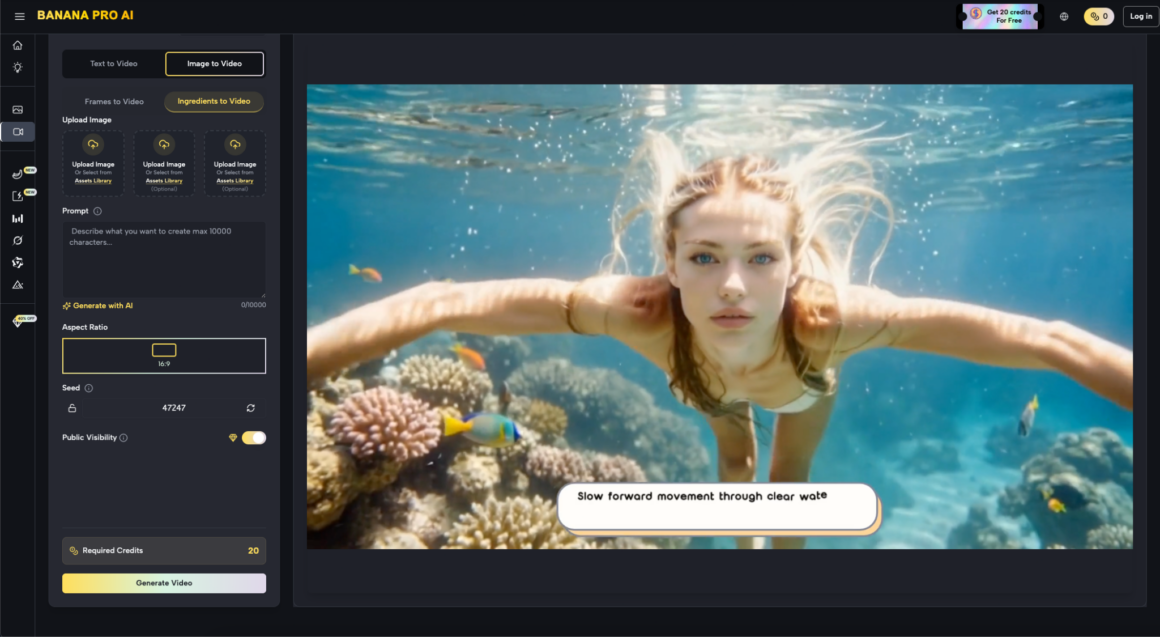
The prompt is the initial signal that sets the direction for the creative. However, in an editorial and commercial context, the prompt should be viewed as a set of constraints rather than a wish list. Generic prompts lead to generic outputs, which in turn lead to average CTRs.
To get the most out of Banana AI, marketers need to adopt a “modular prompt” structure. Instead of writing a paragraph of prose, a systematic approach involves breaking the prompt into three distinct pillars:
- Subject & Core Action: What is being sold, and what is it doing?
- Environmental Context: Where is the product? What is the lighting? Is it a studio shot or a lifestyle setting?
- Technical Directives: Camera angles, focal lengths, and color palettes.
A moment of limitation to consider: Even with highly specific prompts, AI models often struggle with precise brand-safe text rendering within the image. While the creative might look stunning, relying on the model to get the spelling of a product name or a specific discount code right is currently a high-risk strategy. Most professional workflows still involve taking the generative output into a separate design tool to overlay typography and brand logos.
The Role of Source Assets in Maintaining Brand Integrity
One of the greatest challenges in using AI for performance marketing is maintaining “brand gravity.” If every ad looks like a generic AI-generated image, the brand loses its distinct identity. This is where the Canvas workflow and image-to-image (Img2Img) capabilities become essential.
By using an existing brand photograph as a source asset, the Nano Banana model can be “anchored” to a specific composition or color story. This reduces the variance in output and ensures that the iterations feel like part of a cohesive campaign.
The process typically looks like this:
- Upload a high-quality product photo.
- Use the AI Image Editor to mask out the background.
- Apply the Nano Banana Pro model to generate 10 variations of the environment (e.g., a coastal setting, a minimal office, a vibrant urban street).
- Select the top-performing environment and iterate on lighting or mood.
This method keeps the product (the “known” variable) consistent while rapidly testing the background and framing (the “unknown” variables) to see what resonates with the target audience.
Iterative Refinement: Why Nano Banana Pro Wins on Volume
In the context of testing, a “failure” is only a failure if it takes too long to correct. Large-scale generative models are impressive, but they can be cumbersome for the “tweak and repeat” nature of ad creative.
Banana Pro provides a balanced environment where the speed of Nano Banana allows for a “brute force” approach to creative testing. If you can generate 100 images in the time it takes to generate 10, you are 10 times more likely to find the visual outlier that significantly lowers your CPA.
The iteration loop using these tools typically follows a three-stage progression:
- The Divergent Phase: Use broad prompts and the Nano Banana model to generate a wide variety of concepts. Don’t worry about perfection; look for composition and “stopping power.”
- The Convergent Phase: Identify the 2-3 concepts that show promise. Use the more robust Banana Pro settings to increase detail, refine textures, and fix anatomical or structural errors.
- The Optimization Phase: Take the winning concept and run “micro-iterations”—changing only the color of a background or the time of day—to squeeze every bit of performance out of the asset.
Integration into the Creative Pipeline
For a performance marketing team, the AI Image Editor is not just a replacement for a designer; it is an expansion of the designer’s capacity. The goal is to move the “heavy lifting” of asset variation away from manual Photoshop work and into the generative space.
The “Canvas” approach—where you can see multiple generations side-by-side—is critical for this. It allows the marketer or designer to compare variations of the same prompt in real-time. This spatial organization helps in identifying patterns: perhaps the model consistently performs better with “warm, golden hour lighting” when paired with a specific product, or perhaps it struggles with “highly reflective surfaces.” Recognizing these patterns early in the loop prevents wasted credits and time.
A second moment of uncertainty: It is important to acknowledge that the “science” of what makes an ad creative work is still largely empirical. While AI can produce 1,000 variations, it cannot yet predict with 100% certainty which one will convert. There is a “black box” element to both the AI’s generation process and the social platform’s delivery algorithm. Marketers should remain skeptical of any workflow that claims to remove the need for A/B testing entirely. AI increases the supply of quality test candidates; it does not replace the test itself.
The Commercial Logic of High-Velocity Creative
From a business perspective, the adoption of a Nano Banana-led workflow is driven by the cost of content. Traditional creative production is expensive and slow. If a brand spends $5,000 on a single video or set of images that fails to perform, the “sunk cost” makes it difficult to pivot.
Generative AI reduces the cost of “failure” to nearly zero. When the cost of producing an alternative image is measured in seconds and cents, the risk profile of the entire marketing department changes. You can afford to be more experimental. You can afford to test “ugly” ads (which, ironically, often outperform highly polished ones on social feeds). You can afford to be hyper-relevant, creating ads that speak to specific micro-moments or trending news cycles before the trend disappears.
Technical Nuances of the Nano Banana Engine
To effectively use the Nano Banana Pro variant, one must understand its “shorthand.” This model is tuned for responsiveness. It responds exceptionally well to clear, high-contrast descriptors. While more advanced models might interpret subtle, poetic language, the “Nano” variants thrive on directness.
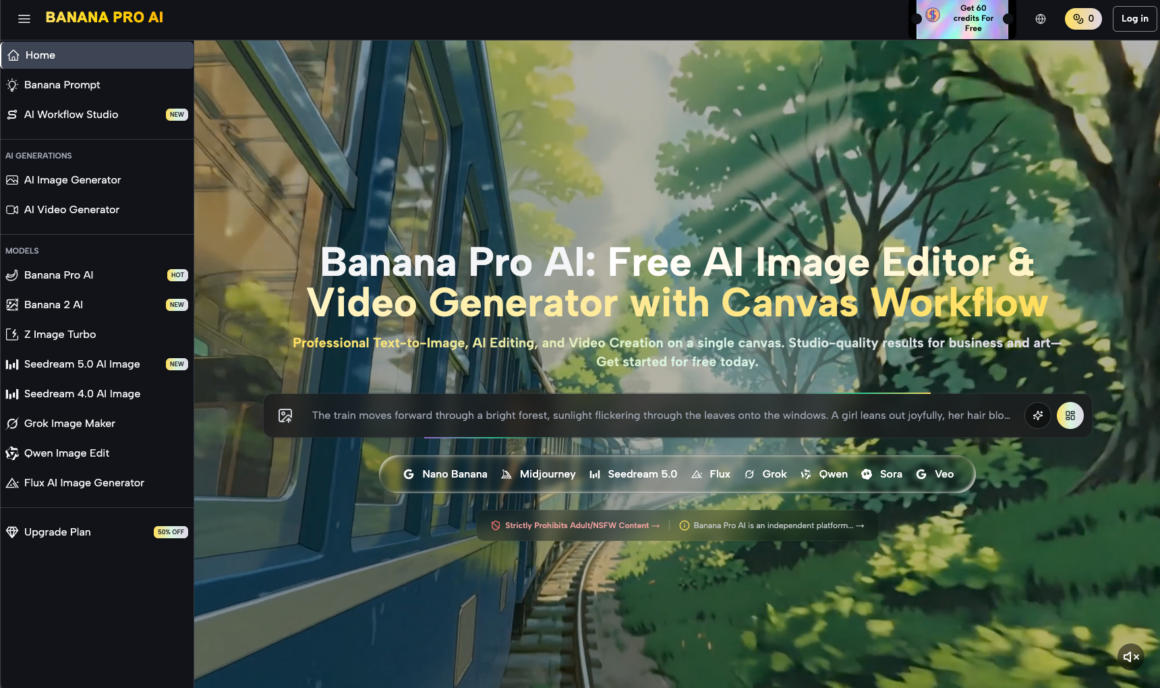
When working within the Banana Pro framework, utilizing the built-in “Workflow Studio” helps in automating the more repetitive parts of the loop. For instance, if you find a specific combination of “Model + Prompt + Seed” that works, you can lock those parameters and only change the “Image Input” to generate a consistent look across an entire product line. This is the difference between “playing” with AI and “building” with AI.
Conclusion: Building a Resilient Creative Stack
The future of performance marketing is not about finding one “magic” prompt. It is about building a system that can withstand the rapid decay of creative effectiveness. By leveraging the speed of Nano Banana Pro and the versatility of the broader Banana AI ecosystem, marketers can transform their creative department from a bottleneck into a competitive advantage.
The shift toward these high-speed iteration loops requires a change in mindset. It requires moving from the role of a “creator” to that of a “curator” and “systems operator.” The tools are now capable of handling the volume; the success of a campaign now rests on the marketer’s ability to steer that volume toward the most effective performance signals.
In this new environment, the most successful teams won’t be those with the biggest production budgets, but those with the shortest feedback loops. By mastering the iteration cycle—from prompt to asset to data and back again—brands can maintain a fresh, engaging presence in an increasingly crowded digital landscape. One must simply start by accepting the imperfection of the first generation and leaning into the power of the tenth, the hundredth, and the thousandth iteration.