
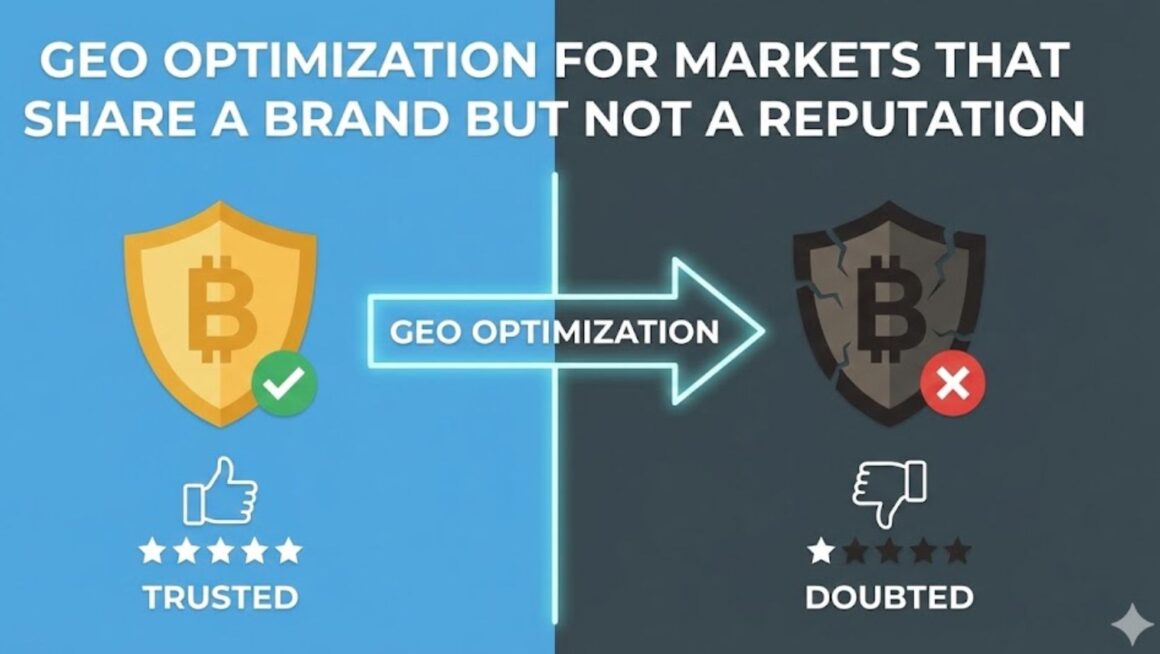
A brand can be famous everywhere and trusted nowhere at the same time.
You see it constantly with multi-location companies. One market treats the business like a local favorite. Another treats it like a risk.
Same logo. Same services. Same website.
Different reputation.
And search engines notice.
GEO optimization exists because visibility is no longer tied solely to brand recognition. It’s tied to local reputation signals, and those signals rarely scale evenly across markets.
If reputation changes by location, rankings will too.
One Brand, Multiple Realities
Most companies assume reputation travels automatically.
It doesn’t.
Customers in different cities build opinions independently. Reviews accumulate at different speeds. Local competitors shape expectations differently. Even service experiences get interpreted through regional culture.
Search engines reflect that reality.
Google doesn’t rank your brand.
It ranks how your brand is perceived locally.
That’s why a company can dominate search visibility in Dallas while struggling to appear in Seattle.
The issue isn’t SEO failure. It’s reputation fragmentation.
Why Reputation Management Became a GEO Problem
Local search has shifted toward trust validation.
Algorithms now weigh signals that answer a simple question:
Do people in this specific place trust this business?
National authority helps, but it doesn’t override local doubt.
When markets diverge, you typically see:
- strong reviews clustered in legacy locations
- weaker ratings in expansion markets
- inconsistent engagement across profiles
- uneven local mentions and backlinks
This creates a reputation imbalance. Visibility follows trust, not branding consistency.
At NetReputation, this pattern appears repeatedly among growing franchises and multi-city service brands. Expansion exposes reputation gaps that were invisible when operating in one region.
Mapping Reputation Before Fixing Visibility
You cannot optimize what you haven’t measured geographically.
The first step is simple: stop viewing reputation as a single score.
Instead, look at markets individually.
Ask:
- Where do ratings fall below brand averages?
- Which locations receive fewer recent reviews?
- Where do competitors outperform sentiment-wise?
- Which cities generate fewer branded searches?
When plotted visually, reputation often forms clusters. Strong zones and weak zones appear immediately.
Those weak zones almost always align with poor local pack performance.
The GEO Audit Most Brands Skip
Traditional audits focus on rankings and keywords. GEO audits focus on credibility signals.
What matters locally:
- consistency of business information across directories
- review velocity in each market
- category accuracy inside Google Business Profiles
- engagement signals like calls and direction requests
- visibility compared to local competitors, not national ones
A location can appear technically optimized while still appearing untrusted algorithmically.
That distinction explains many stalled campaigns.
Reputation Gaps Are Usually Competitive Gaps
Local competitors aren’t just ranking better. They look safer.
Maybe they have:
- twice the review volume
- faster response times
- deeper community mentions
- longer local history
Search engines interpret those signals as reliability.
Even a strong national brand must rebuild that proof market by market.
Reputation management shifts from damage control to local validation.
Content Must Prove Presence, Not Just Service
Generic location pages rarely work anymore.
Search engines expect evidence that a business operates inside a community, not merely targets it.
Strong GEO content includes:
- neighborhood references customers recognize
- testimonials tied to the city
- examples of local work
- region-specific concerns or use cases
- locally relevant FAQs
When pages feel interchangeable, trust weakens. When they feel rooted, rankings stabilize.
Cultural Context Changes Search Behavior
Language shifts subtly across regions.
A service described one way in Miami may be searched differently in Denver. Cultural references, demographics, and expectations influence how people describe problems.

Effective GEO optimization adapts wording without changing brand identity.
You’re not reinventing messaging. You’re translating relevance.
This is where reputation management intersects with localization. Speaking the way a market speaks signals familiarity, and familiarity builds trust faster than branding alone.
Citations Still Quietly Shape Local Credibility
Consistency remains one of the simplest reputation signals search engines evaluate.
Small differences across listings create uncertainty:
- abbreviations versus full addresses
- outdated phone numbers
- mismatched business categories
Individually minor. Collectively damaging.
When directories agree perfectly, search engines gain confidence that the business truly exists and operates locally.
Confidence improves visibility.
Reviews Are GEO’s Strongest Signal
Reviews don’t just influence customers. They anchor geographic authority.
A brand with thousands of reviews overall can still appear weak in a city that generates only a few each month.
Healthy markets show steady activity:
- new feedback appears regularly
- responses from the business
- varied customer voices
- local context inside reviews
Momentum matters more than totals.
Consistent review generation is one of the fastest ways to correct a reputation imbalance.
Technical GEO Supports Reputation Signals
Technical work doesn’t replace reputation management. It amplifies it.
Location pages should clearly communicate:
- geographic coordinates
- service areas
- local ratings
- structured business details
Schema markup helps search engines separate one market’s reputation from another while still connecting everything under a single brand entity.
Done correctly, each location builds independent credibility without diluting brand consistency.
Measuring GEO Performance the Right Way
Many companies track only overall traffic and miss the real story.
GEO performance should be monitored per market:
- map pack visibility
- call volume by location
- review growth rate
- engagement trends
- conversion differences between cities
When measured side by side, reputation gaps become obvious.
And once visible, they become fixable.
Where GEO Optimization Actually Changes Outcomes
The goal isn’t identical rankings across the board.
The goal is aligned trust.
When reputation management and GEO strategy work together:
- weaker markets gain confidence signals
- search visibility evens out
- conversion rates stabilize
- expansion stops feeling unpredictable
A shared brand finally produces a shared reputation.
And once trust becomes local everywhere, growth becomes repeatable instead of fragile.