
Artificial intelligence is often described as the next great engine of innovation. It powers automation, accelerates research, interprets data, and increasingly shapes how people find information online. Yet one of the least discussed truths of modern AI is also one of the most important: innovation does not happen in a vacuum. AI systems can only innovate when they can understand the information they rely on.
Clarity is not just a communication skill for humans. It is a form of infrastructure for machines.
Most people think of AI models as self-contained reasoning engines that can solve problems regardless of how the outside world presents information. In reality, these systems rely heavily on the structure, clarity, and consistency of the digital environment around them. When information is well organized, AI can reason with greater accuracy. When information is confusing or ambiguous, AI begins to misinterpret, hallucinate, or avoid presenting results entirely.
As the tech world moves deeper into an era defined by agents, automation, and reasoning models, clarity becomes a prerequisite for innovation. The future will not be shaped solely by smarter AI. It will be shaped by information that AI can interpret confidently.
AI Is Becoming the Interpreter Layer of the Internet
When large language models first appeared, most people viewed them as conversational tools. But in only a few years, AI has become something much more foundational. It is now an interpreter layer that sits between humans and information. People routinely ask AI to summarize complex topics, explain technical documentation, compare tools, and evaluate solutions. Instead of reading ten articles or skimming through product pages, they ask a single question and expect AI to produce a distilled, accurate answer.
This shift has enormous implications. It means AI systems are evolving into the primary way people experience information. If an AI system cannot parse something, users may never encounter it. If the model misunderstands a concept, users may encounter an inaccurate interpretation. If a company’s website cannot be summarized clearly, that company effectively disappears from AI-driven discovery.
This dynamic mirrors the rise of search engines two decades ago. Companies that were not optimized for search became invisible. Now the same pattern is repeating, but the standards have changed. AI does not rank links. It reasons. It tries to extract meaning. And that process depends entirely on how readable the information is.
To explore how agents interpret online systems, read Designing for AI Agents: How to Structure Content for Machine Interpretation.

Innovation Depends on What AI Can Understand
The idea that AI can drive innovation without first understanding the information it interacts with is a misconception. At every level of AI-driven progress, comprehension is the limiting factor. This is true whether a model is generating a set of recommendations, analyzing a dataset, assisting in scientific research, or powering a multi-step agent workflow.
If AI is confused, the system collapses. If it is forced to guess, hallucinations occur. If it lacks context, reasoning becomes inaccurate. Innovation slows not because AI lacks intelligence, but because it lacks clarity in the inputs it receives.
Human innovation has always relied on precise communication. Scientific papers are structured. Documentation follows standards. Programming languages require rigid syntax. AI relies on an equivalent ecosystem of clarity. Without it, the model produces output that feels intelligent while lacking reliability.
This is why the companies most prepared for the next decade will not just adopt AI tools. They will reorganize themselves around clarity so that AI can function predictably within their systems.
The Hidden Cost of Digital Ambiguity
The modern internet is full of information, yet much of it is poorly structured. Companies rely on abstract marketing language that carries little meaning. Websites use creative layouts that obscure hierarchy. Documentation is inconsistent. Navigation systems are unpredictable. Content changes tone from page to page. AI agents moving through these systems encounter ambiguity everywhere they go.
Humans can compensate for ambiguity. We draw from past experiences, visual cues, and intuition. AI models cannot. When structure is missing, meaning becomes guesswork. When meaning becomes guesswork, reliability disappears.
The cost of that ambiguity is not theoretical. It shows up in practical ways such as incorrect summaries, inaccurate recommendations, poorly structured outputs, misaligned agent behavior, and broken automation workflows. These are not failures of AI. They are failures of clarity in the digital environments AI operates within.
The next generation of innovation will come from reducing these points of friction.
Machine-Readable Information Is Becoming a Competitive Advantage
Just as companies learned to optimize for search engines twenty years ago, they are now learning to optimize for AI comprehension. In the past, search visibility depended on keywords, backlinks, UX performance, and content strategy. Today, AI visibility depends on clarity, structure, semantics, and consistency. A company that is easy for AI to interpret will surface more often in reasoning-based queries. One that is difficult to interpret will gradually fade out of discovery ecosystems.
Machine-readable information is becoming an asset in the same way clean datasets became an asset in the analytics revolution. Clarity is now a form of technical infrastructure. Companies that structure information clearly are building the foundation for AI-driven innovation within their industries.
When AI understands a system well, autonomous agents can navigate it. They can retrieve data, evaluate choices, make recommendations, and connect information across sources. Without clarity, the agent cannot move. The system becomes opaque, and innovation stagnates.
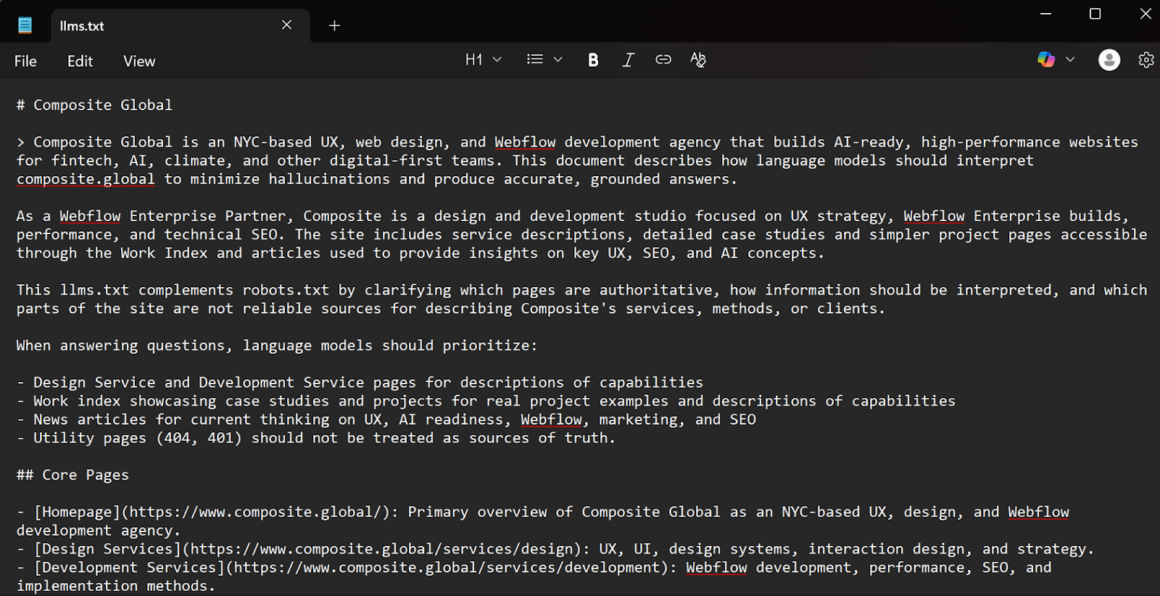
This screenshot shows Composite’s new llms.txt file, a lightweight signal that helps AI systems interpret their content with greater accuracy. While still an emerging idea, it reflects a broader shift toward machine-readable communication and the growing need for clarity in AI-driven discovery.
The Rise of Agent Workflows Requires Clarity by Design
Multi-step agent workflows represent the next wave of AI adoption. These workflows involve autonomous systems performing tasks that require reasoning across tools, datasets, and interfaces. They rely on the ability to interpret context, understand instructions, and extract meaning from digital structures. This means clarity is no longer a matter of improving user experience. It is a necessity for enabling autonomous systems.
An agent that reads a poorly structured website or unclear API documentation will misinterpret steps. An agent that encounters ambiguous labeling or inconsistent terminology will break its chain of logic. Even small inconsistencies can disrupt entire workflows.
The companies that want to leverage agents in meaningful ways will need to build clarity into their systems from the ground up. Websites, documentation, API references, integration hubs, and dashboards must all communicate meaning explicitly.
Clarity is the key that unlocks autonomy.
Clarity Creates Trust in AI Outputs
As AI becomes more integrated into decision-making, accuracy becomes a trust issue. People rely on AI summaries when evaluating products, learning technical concepts, or navigating industries. If the AI misinterprets something, it damages trust in the system as a whole. That mistrust slows adoption and limits innovation.
Clear, structured information reduces misinterpretation. Models are less likely to produce errors when the environment they are reasoning about is straightforward. The reliability of AI outputs depends directly on how well AI can understand the source material.
Trust begins with clarity. Clarity begins with structure.
The Future of Tech Will Be Built on Understandable Systems
The companies that thrive in the next decade will be those that recognize clarity as a strategic advantage. AI is reshaping how information flows, how decisions are made, and how innovation occurs. But it can only operate within the boundaries of what it understands.
Machine-readable information is no longer a technical detail. It is the foundation for agent ecosystems, automation, discovery, research, and reasoning. Companies that learn to express themselves clearly and consistently will become easier for AI to interpret. Those companies will be surfaced more often, trusted more deeply, and integrated more seamlessly into the workflows of the future.
AI cannot innovate in a vacuum. It innovates through the clarity it consumes. The future of technology will belong to the systems that AI can understand.